
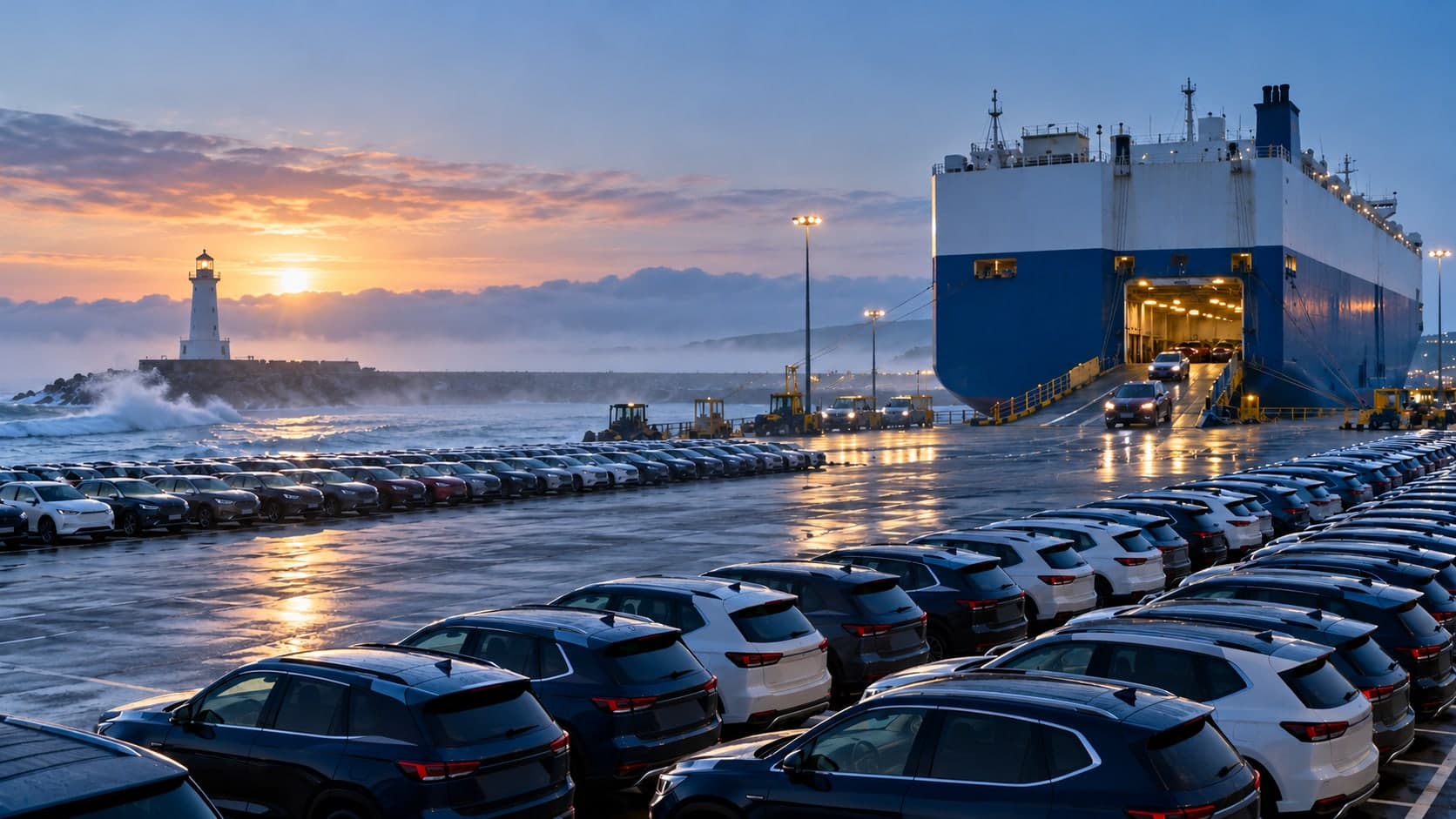
Cars built for the Chinese market do not always have EU approval, and what is needed to register one in France depends on the make, model and version.
Ports and routes
We quote sea freight to two French ports: Le Havre, on the Channel coast, and Marseille, on the Mediterranean. Cars leave China from Shanghai, Tianjin or Guangzhou, depending on where the car is and which services reach your port. Freight rates change, so the figure that counts is the one in your proforma invoice. Estimates with their quote dates are listed on this page and in the cost calculator on each car page; the sailing is confirmed for each car.
France
| Departure port | Destination port | Quoted | Estimated ocean freight |
|---|---|---|---|
| Guangzhou | Le Havre Guangzhou → Le Havre, about 36 days at sea | $2,200 | |
| Shanghai | Le Havre Shanghai → Le Havre, about 36 days at sea | $2,200 | |
| Tianjin | Le Havre Tianjin → Le Havre, about 36 days at sea | $2,200 | |
| Guangzhou | Marseille Guangzhou → Marseille, about 34 days at sea | $2,000 | |
| Shanghai | Marseille Shanghai → Marseille, about 34 days at sea | $2,000 | |
| Tianjin | Marseille Tianjin → Marseille, about 34 days at sea | $2,000 |
Container or RoRo
RoRo
Driven on and off a vehicle carrier. The car must be drivable, and personal belongings are generally not allowed inside.
Container
Secured inside a container with straps and wheel chocks; how the container is loaded is set out in your written shipping plan. Suits a car that does not run or needs extra protection.
Import rules
A car arriving from outside the European Union goes through customs clearance, where import duty and VAT are assessed. To register it in France, you then need proof of customs clearance and proof that the car meets EU and French technical requirements. Depending on the car, that may be a certificate of conformity (COC) recognised in the EU or an individual approval, which can take time and cost money.
Documents
Before documents are issued, we need the consignee details, written exactly as your broker needs them. Export paperwork and documents explains each one.
What you receive
- Commercial invoice and packing list
- Bill of lading
- Export customs declaration
- Vehicle deregistration certificate
- Certificate of origin, on request
What your broker usually asks for
- Commercial invoice and bill of lading
- Importer's identification and, where needed, an EORI number
- Technical data: VIN, engine, fuel type and dates
Costs on arrival
Before payment, your written proforma invoice identifies the car and VIN, the FOB price, any ocean freight and cargo insurance, the agreed ports and trade term, payment terms and the bank details. Import duties, taxes, destination charges, customs broker fees and registration costs are not included.
- import duty and VAT
- port and terminal charges, and storage if collection is late
- customs broker fees
- conformity and registration costs, including any approval and technical checks
Customs clearance at the destination is done by you or your customs broker.
New arrivals
The listed price is the FOB price in US dollars. It includes the car, inspection, export documents and customs clearance, domestic transport, port charges and service fee. CFR adds estimated ocean freight to the FOB price. CIF adds estimated cargo insurance to CFR. Import duties, taxes, destination charges, customs broker fees and registration costs are not included.
Common questions
Which port suits me?
Usually the one nearer to you or to your customs broker: Le Havre for Paris and the north, Marseille for the south. Services and sailing dates differ between the two, so your sales manager can compare both for your car before you decide.
Is the car ready for French registration on arrival?
No. The car arrives with export documents from China, not French registration papers. Customs clearance, proof of conformity and registration are separate steps at your end, handled by you or your broker.
Do electric cars need extra checks?
Yes. Cars built for China typically use the Chinese GB/T charging standard, while public chargers in France use Type 2 and CCS2 connectors, so compatibility and adapters matter, along with battery health and language settings. See Used electric and hybrid cars.
Do you handle French customs?
No. We handle the export side in China: inspection, export paperwork and shipping. Customs clearance in France is done by you or your customs broker. We send your broker the documents and answer their questions about the car.